
E-BOOK LAW (HUKUM)
Law, Society and Corruption
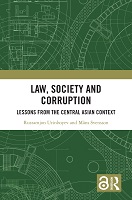
Law, Society and Corruption Proposal review Lessons from the Central Asian Context
- Title
-
Law, Society and Corruption
Proposal review Lessons from the Central Asian Context - https://drive.google.com/file/d/1Jemv1giVgkFKz8ddBB9tSlnMPZ5zaqF4/view?usp=drive_link
- Creator
-
Urinboyev, Rustamjon
Svensson, Måns - Date
- 2025
- Description
- This book presents new socio-legal perspectives and insights on the social life of corruption and anticorruption in authoritarian regimes. This book takes up the case of Uzbekistan—an authoritarian regime in Central Asia and one of the most corrupt countries in the world according to Transparency International’s Corruption Perceptions Index—and examines the corruption that developed in a tightly closed authoritarian regime permeated by a large-scale shadow economy, a weak rule of law, and a collectivist legal culture. Building on socio-legal frameworks of legal compliance, living law and legal pluralism, the central argument of the book is that the roles, meanings, and logics of corruption are fluid, and depend on a myriad of structural variables, and contextual and situational factors. This book will be of value to researchers, academics, and students in the fields of sociology of law, legal anthropology, and Central Asian studies, especially those with an interest in the intersection of law, society, and corruption in authoritarian regime contexts.
Chapter 4 Consequentialism and the Law in Medicine
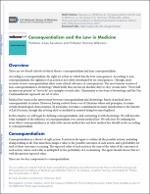
Chapter 4 Consequentialism and the Law in Medicine
- Title
- Chapter 4 Consequentialism and the Law in Medicine
- https://drive.google.com/file/d/1hJQm72-Tfg8DIZ3hV8zOmdDOA-7Kjoic/view?usp=drive_link
- Creator
- Savulescu, Julian Wilkinson, Dominic
- Date
- Oxford, 2019
- Description
- There are two broad schools of ethical theory: consequentialism and non-consequentialism. According to consequentialism, the right act is that act which has the best consequences. According to non-consequentialism, the rightness of an action is not solely determined by its consequences. (Though, most versions of non-consequentialism allow some ethical relevance of consequences). The most famous version of non-consequentialism is deontology, which holds that one has an absolute duty to obey certain rules. “Never kill an innocent person” or “never lie” are examples of such rules. Christianity is one form of deontology and the Ten Commandments represent one set of rules. Medical law exists at the intersection between consequentialism and deontology. Much of medical law is consequentialist in nature. However, having evolved from a set of Christian values and principles, it retains certain deontological characteristics.
Sustainable Development Goals and Human Rights
Sustainable Development Goals and Human Rights
- Title
- Sustainable Development Goals and Human Rights
- https://library.oapen.org/viewer/web/viewer.html?file=/bitstream/handle/20.500.12657/22942/1007219.pdf?sequence=1&isAllowed=y
- Creator
-
Kaltenborn, Markus (editor)
Krajewski, Markus (editor)
Kuhn, Heike (editor) - Date
- 2020
- Description
- This book analyses the interplay of sustainable development and human rights from different perspectives including fight against poverty, health, gender equality, working conditions, climate change and the role of private actors. Each aspect is addressed from a more human rights-focused angle and a development-policy angle. This allows comparisons between the different approaches but also seeks to close gaps which would remain if only one perspective would be at the center of the discussions. Specifically, the book shows the strong connections between human rights and the objectives of the 2030 Agenda for Sustainable Development and the Sustainable Development Goals adopted by the United Nations in 2015. Already the preamble of this document explicitly states that “the 17 Sustainable Development Goals ... seek to realise the human rights of all”. Moreover, several goals and targets of the 2030 Agenda correspond to already existing individual human rights obligations. The contributions of this volume therefore also address how the implementation of human rights and SDGs can reinforce each other, but also point to critical shortcomings of the different approaches.
- Publisher
- Springer Nature
Glocal Governance How to Govern in the Anthropocene?
Glocal Governance How to Govern in the Anthropocene?
- Title
- Glocal Governance How to Govern in the Anthropocene?
- https://drive.google.com/file/d/19TYL3JgnLoZdvKR87zGNYA-ALHqp1aCD/view?usp=drive_link
- Creator
- Mihr, Anja
- Date
- Cham, 2022
- Description
- This open access book develops a conceptual framework for glocal governance as a multi-stakeholder local governance approach based on global human rights norms and democratic principles. It discusses glocal governance as part of an ongoing global transformation process that began in the 1990s, when democracy and individualizing responsibilities for governance became the dominant political system worldwide, and continues through today’s dawn of a New Cold War between those countries which have democratized and those which haven’t. This book will intrigue practitioners and scholars alike who are interested in the concepts of glocality and glocalism, local-global connectivity, and the implementation and dissemination of global norms and concepts such as human rights and democracy, at the local and community level as well as among civil society and private enterprises.
Narrating the Rule of Law Patterns in East Central European Parliaments

Narrating the Rule of Law Patterns in East Central European Parliaments
- Title
-
Narrating the Rule of Law
Patterns in East Central European Parliaments - https://drive.google.com/file/d/1f9FZLhRKDTb60iJtjxFnDXSJ2esLbvzi/view?usp=drive_link
- Creator
- Lorenz, Astrid Anders, Lisa H. Müller, Dietmar Němec, Jan
- Date
- Cham, 2024
- Description
- This open access book deals with the backsliding of the rule of law in Poland and Hungary as one of the main problems of the EU. What began as a national phenomenon has become a general threat for the EU because the respect for the rule of law is a prerequisite for all other values of the EU enshrined in Article 2 of the Treaty on European Union. Media coverage and scholarly publications on these developments mainly focus on backsliding governments and judicial decisions concerning the issue. This book aims to inform the debate by adding another perspective and providing a broader view. Drawing on a comprehensive collection of parliamentary debates, we explore how MPs in Poland, Hungary, but also the Czech Republic, Slovakia and Romania referred to the rule of law from 1990 to 2021 and how their narratives differed across parties, countries and time.
Chapter 35 The Mental Health and Justice Project
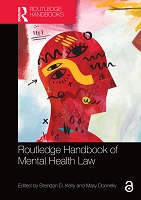
Chapter 35 The Mental Health and Justice project Proposal review Reflections on strong interdisciplinarity
- Title
- Chapter 35 The Mental Health and Justice project Proposal review Reflections on strong interdisciplinarity
- https://drive.google.com/file/d/1bpUwPODNfyunaJdLTfbr593kwB5fsPqH/view?usp=drive_link
- Creator
- Owen, Gareth
- Date
- 2024
- Description
- Mental health law is a rapidly evolving area of practice and research, with growing global dimensions. This work reflects the increasing importance of this field, critically discussing key issues of controversy and debate, and providing up-to-date analysis of cutting-edge developments in Africa, Asia, Europe, the Americas, and Australia. This is a timely moment for this book to appear. The United Nations’ Convention on the Rights of Persons with Disabilities (2006) sought to transform the landscape in which mental health law is developed and implemented. This Convention, along with other developments, has, to varying degrees, informed sweeping legislative reforms in many countries around the world. These and other developments are discussed here. Contributors come from a wide range of countries and a variety of academic backgrounds including ethics, law, philosophy, psychiatry, and psychology. Some contributions are also informed by lived experience, whether in person or as family members. The result is a rich, polyphonic, and sometimes discordant account of what mental health law is and what it might be. The Handbook is aimed at mental health scholars and practitioners as well as students of law, human rights, disability studies, and psychiatry, and campaigners and law- and policy-makers.